Skip to content
(417) 625-4842
Utility-scale containerized battery energy storage installation

For C&I storage developers, EPCs & asset owners

The storage asset is only bankable if the cells behind it are.

Financing rests on a cycle-life warranty that has to be good in year ten. Most integrators buy cells from a factory they have never walked, badge the container, and hand you the warranty risk in the contract you sign.

We make the cell and we build the container. When you ask who stands behind the degradation curve, it is one answer, from a company that has been manufacturing batteries since 1994 and is listed on the Shenzhen Stock Exchange.

Bring us a one-line diagram or a load profile. You will get real specifications and an honest read on the code pathway.

215 kWh – 6.48 MWh
Cabinet to container
5 LFP formats
280 / 314 / 348 / 580 / 628Ah
Liquid or air
Matched to duty cycle
50 MW / 100 MWh
Largest deployed project

Sound familiar?

The storage bid is easy to win and hard to underwrite.

  • Three bids arrive within a few percent of each other and none of them names the cell manufacturer.
  • The cycle-life warranty is 20 years long and the company offering it is four years old.
  • Your lender's technical advisor asks for degradation data and the integrator forwards a datasheet.
  • The container was designed around whatever cell was available the quarter it was quoted.
  • Nobody can tell you what happens to the warranty if the cell supplier changes mid-project.
  • The fire marshal asks a question the vendor answers with a standard from the wrong continent.

What is actually in the box

A BESS is five subsystems. Price only one and you bought a risk.

Use this to compare bids. If a proposal does not identify all five and who is responsible for each, the gaps are not gone — they moved onto your side of the contract.

  1. 01

    Battery modules

    LFP cells assembled into modules and racks. This is where the energy lives and where the warranty risk sits. Cell chemistry, format, and the factory that made it determine the degradation curve your financial model depends on.

    We manufacture the cells — 280, 314, 348, 580 and 628Ah LFP formats — and assemble the system. One company answers for both.

  2. 02

    Battery management system (BMS)

    Monitors voltage, current, and temperature at cell, module, and rack level; balances cells; and enforces protection limits. A BESS is only as safe and as long-lived as its BMS is honest about what it sees.

    Module-level temperature monitoring with no unmonitored cells, plus insulation fault detection. On our UPS line we also add CO detection for early thermal-runaway warning.

  3. 03

    Power conversion system (PCS)

    The bidirectional inverter between DC batteries and the AC grid. It sets your round-trip efficiency, your grid-code compliance, and whether the plant can ride through a disturbance.

    Integrated in our containerized products at rated power — 50kW, 105kW, 125kW and 500kW blocks — so the DC and AC sides are matched at the factory rather than on site.

  4. 04

    Thermal management

    Liquid or air cooling that holds cells inside their happy band. Temperature spread between cells is the quiet killer of cycle life: the coldest cell limits capacity and the hottest cell limits life.

    Liquid-cooled and air-cooled variants, both rated −22 °F to +131 °F (−30 °C to +55 °C) and 0–95% humidity. Liquid cooling for high-throughput cycling, air for lower-duty and PV-paired sites.

  5. 05

    Safety and fire protection

    Detection, suppression, and enclosure design. This is the subsystem your fire marshal, your insurer, and your lender all care about, and the one most often under-specified in a bid.

    Aerosol, FK-5-1-12, or HFC-227ea suppression options, IP55 enclosures on the container products, and multi-layer protection at module level.

Published specifications, in US units

What we build today.

Metric figures are the manufacturer’s published data. Feet, inches and pounds are converted so you can check clearances and foundation loading without a calculator.

ModelRated energyCellCoolingFootprint (W×D×H)WeightEnclosure
CBES-6.48MWh6.48 MWhLFP 3.2V / 348AhLiquid23.8 × 8.0 × 10.2 ft7260 × 2438 × 3100 mm≈121,300 lb (≈55 t)IP55
CBES-5MWh5 MWhLFP 3.2V / 314AhLiquid19.9 × 8.0 × 9.5 ft — 20 ft ISO6058 × 2438 × 2896 mm99,200 lb (45 t)IP55
CBES-500kW / 1MWh1,075.2 kWhLFP 3.2V / 280AhAir19.9 × 8.0 × 9.5 ft — 20 ft ISO6058 × 2438 × 2896 mm39,700 lb (18 t)IP55
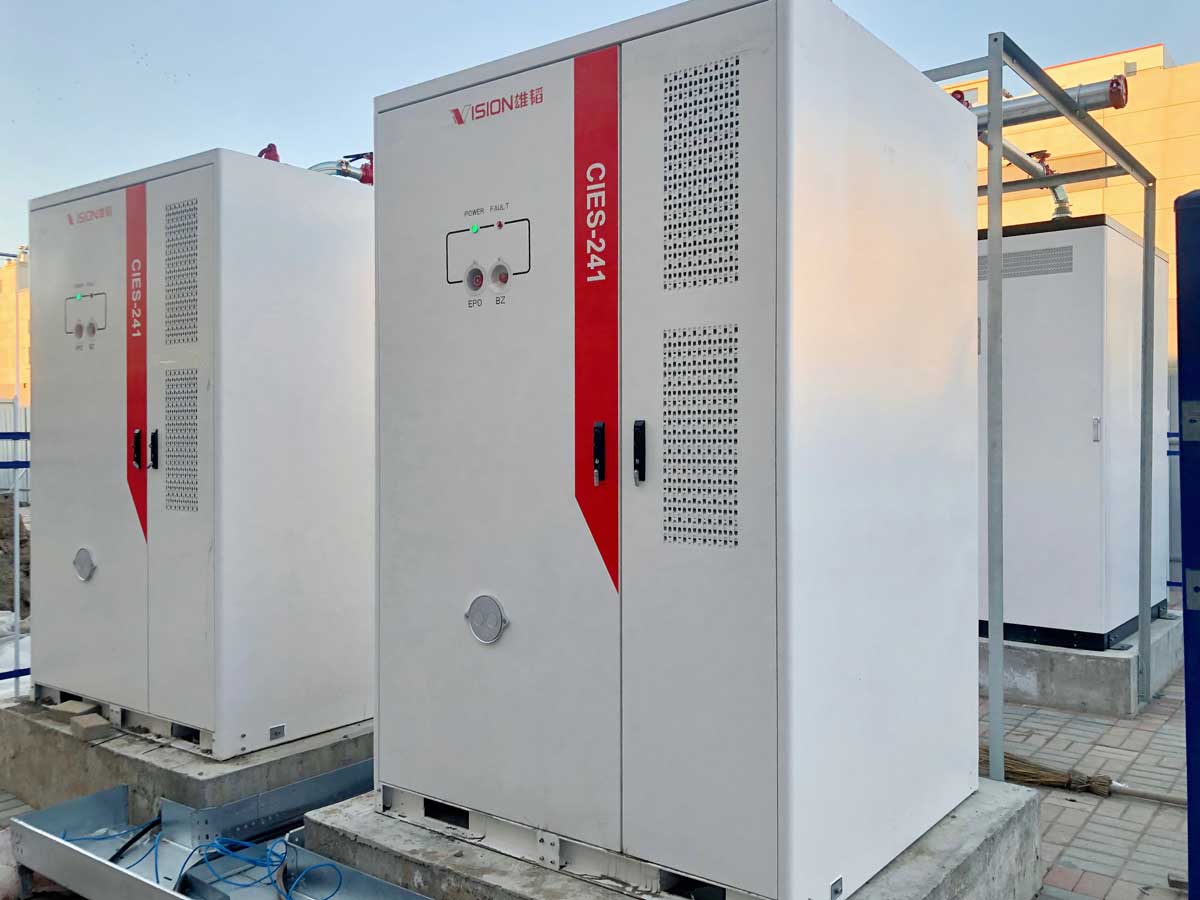
CBES-125kW / 261kWh261 kWhLFP 3.2V / 314AhLiquid59.1 × 55.1 × 87.6 in1500 × 1400 × 2225 mm6,170 lb (2.8 t)Outdoor rated
CBES-50/105kW · 215–229kWh215 or 229 kWhLFP 3.2V / 280AhAir66.9 × 49.6 × 90.6 in1700 × 1260 × 2300 mm5,510–5,730 lb (2.5–2.6 t)Outdoor rated

All models: −22 °F to +131 °F (−30 °C to +55 °C), 0–95% relative humidity. Liquid-cooled cabins rated to 9,842 ft (3,000 m). Interfaces: Ethernet, CAN, RS485. Protocols: Modbus TCP/IP; Modbus and IEC 61850 on the liquid-cooled cabins. Suppression options: aerosol, FK-5-1-12, or HFC-227ea.

CBES liquid-cooled cabin
CBES liquid-cooled cabin5 MWh and 6.48 MWh
CBES C&I container
CBES C&I container500 kW / 1 MWh
CBES PV-storage / off-grid
CBES PV-storage / off-grid215–229 kWh
6.48 MWh liquid-cooled ESS
6.48 MWh liquid-cooled ESSLaunched 2025

The part most integrators cannot show you

These are our cells, not a cell we sourced.

Five large-format LFP cells in production. When your technical advisor asks which cell is in the container and who made it, the answer is the same company that signs the warranty.

Vision 280Ah LFP prismatic cell

280Ah

LFP 3.2V

Vision 314Ah LFP prismatic cell

314Ah

LFP 3.2V

Vision 348Ah LFP prismatic cell

348Ah

LFP 3.2V

Vision 580Ah LFP prismatic cell

580Ah

LFP 3.2V

Vision 628Ah LFP prismatic cell

628Ah

LFP 3.2V

The part other vendors skip

We will tell you where the US paperwork stands before you draw us in.

In the United States, an energy storage installation answers to a plan reviewer and a fire marshal. They ask for UL 9540 listing, UL 9540A fire-propagation test data, and compliance with NFPA 855 for siting and separation. IEC certification is real engineering work and it is not a substitute for those.

Our published container documentation lists GB/T and IEC standards. It does not list UL 9540. So before a Vision container goes into a US drawing, ask us for the current listing and test status for that exact model and revision. If the answer is not yet, you will hear not yet.

For context on capability rather than paperwork: our REVO 3.0 UPS lithium system is UL 1973 certified and UL 9540A tested with no fire after thermal runaway, with IEC 62619 (CB Scheme), UN 38.3 and IEC 60068 alongside. North American test programs are not new territory here.

Why say this out loud?

Because you will find out anyway, and the only question is whether you find out from us in week one or from your AHJ in month nine. One of those costs a phone call. The other costs a schedule.

A supplier who will not discuss the gaps in their own documentation is telling you something about how the rest of the project will go.

How a project gets specified

Three steps, and none of them start with a price.

  1. 01

    Duty cycle before hardware

    Cycles per day, depth of discharge, C-rate, ambient range, and the revenue stream the asset serves. That determines liquid versus air, cell format, and how the warranty should be written.

  2. 02

    Code pathway for your jurisdiction

    We confirm the listing and test status for the specific model, and where NFPA 855 puts your spacing and enclosure requirements. You get a written position, not a reassurance.

  3. 03

    Commercial route and lead time

    Which entity invoices, which port it lands at, what is committed versus built to order, and who commissions it. If the project sits outside the US, we tell you which regional entity serves it.

The objections, answered

What developers and lenders push on.

Everyone claims a 20-year warranty.

They do. Ask two follow-ups instead: who manufactured the cell, and who is the legal counterparty on the warranty. If those are two different companies, you are relying on a commercial relationship you are not a party to.

You are not on our approved vendor list.

Not yet, and qualification takes months rather than weeks. That is the argument for starting it now, on a project where nothing is on fire, instead of during a supply squeeze when the schedule cannot absorb a paperwork cycle.

A Chinese supplier is a policy and tariff risk.

It is a real consideration and we will not wave it away. What we can do is be specific: five manufacturing bases, regional entities across Asia, Europe and North America, US inventory in Missouri and Texas, and a purchase route that can be matched to where the project is actually installed. Bring us the constraint and we will tell you whether we can meet it.

We need someone who can support the asset for 20 years.

Then look at the balance sheet rather than the brochure. Vision has manufactured batteries since 1994 and is listed on the Shenzhen Stock Exchange, which means the financials are public and you can read them without asking us.

Our project is not in the United States.

That is straightforward. Vision ships to more than 100 countries. Specify from here, purchase through the entity that serves the installation country. Tell us where the site is and we will tell you who invoices and who commissions.

Deployed at scale, documented

Utility-scale is not a roadmap item here.

50 MW / 100 MWh energy storage system for wind power integration, Hubei

50 MW / 100 MWh

Wind-storage integration, Hubei Province

Fifteen containerized subsystems of 3.35 MW / 6.7 MWh each across roughly 25 acres, paired with a 25-turbine wind farm for peak shaving and grid stability. Vision reports the combined project generating over 220,000 MWh of renewable energy annually.

800V HVDC integrated energy storage and backup power for an AI data center

800V HVDC

AI computing center, Inner Mongolia

Integrated energy storage and backup power for one of China’s largest AI and big-data computing centers, built by a video platform reporting over 900 million daily active users. AI density is changing the power architecture, and storage is being designed in rather than bolted on.

The cell decision is the earliest irreversible decision in a storage project, and it is the one most teams make last. By the time the interconnection agreement lands, the degradation curve in your model has already been chosen by whoever quoted the container.

Nothing about that has a deadline attached to it. It just gets more expensive to change the later it is raised. Qualifying a cell supplier while the project is still on paper costs a few calls.

Next step

Send the load profile. We will send real numbers.

Duty cycle, site, and jurisdiction is enough to start. You get a model recommendation, the cell format behind it, the footprint and foundation loading, and a written read on the code pathway for your AHJ.

  • Cell manufacturer and system integrator are one company
  • 215 kWh to 6.48 MWh, liquid-cooled or air-cooled
  • Regional purchase and commissioning outside the US

Or call (417) 625-4842 Monday–Friday, 8:00–5:00 Central.

An engineer replies, not an autoresponder. We will tell you plainly if a model is not yet listed for your jurisdiction.

Answered plainly

Energy storage questions we get every week.

What does a BESS actually consist of?

Five subsystems. Battery modules store the energy. The battery management system monitors and protects every cell. The power conversion system moves energy between DC batteries and the AC grid. Thermal management holds cells in their optimal temperature band. Safety and fire protection detects and suppresses thermal events. A quoted price that does not identify all five is not a complete system.

Are your containers UL 9540 listed?

The published documentation for the CBES container line lists GB/T and IEC standards — GB/T 36276, GB/T 34120, GB/T 34131, IEC 62619, IEC 62477 and IEC 61000 — and does not list UL 9540. Ask us for the current listing and test status for the exact model and revision you are considering before it goes into a US drawing. We would rather tell you where the paperwork stands than have you discover it at plan review. For context, our REVO 3.0 UPS lithium system is UL 1973 certified and UL 9540A tested with no fire after thermal runaway, so US test programs are not new territory for this company.

Liquid cooling or air cooling — which should I specify?

Duty cycle decides it. If the asset cycles hard and often, liquid cooling holds a tighter temperature spread across cells and protects cycle life, which is why the 5MWh and 6.48MWh cabins are liquid-cooled. If the application is lower-throughput — PV self-consumption, backup, peak shaving a few hours a day — air cooling is simpler, has fewer moving parts, and costs less to maintain. Tell us cycles per day and depth of discharge and the answer is usually obvious.

Why does it matter who makes the cell?

Because the cycle-life warranty is the asset. If your integrator buys cells from whoever quoted lowest this quarter, the warranty behind your financial model is only as good as that integrator's balance sheet and their supplier's willingness to honor it in year eight. Vision manufactures its own LFP cells and has been building batteries since 1994 as a publicly listed company. You can look up the filings.

What communication and protocols are supported?

Ethernet, CAN and RS485 interfaces. Modbus TCP/IP on the cabinet and C&I container products; Modbus and IEC 61850 on the liquid-cooled cabins. Bring us your SCADA or EMS requirement early — protocol mismatches are cheap to solve at design and expensive to solve at commissioning.

What altitude and climate limits apply?

Published ratings are −22 °F to +131 °F (−30 °C to +55 °C), 0–95% relative humidity, and up to 9,842 ft (3,000 m) operating altitude on the liquid-cooled cabins. Derating inside those ranges depends on duty cycle, so ask for the derate curve for your site rather than assuming the corner of the envelope.

Can we buy this outside the United States?

Yes, and that is often the practical route. Vision ships to more than 100 countries with regional entities and five manufacturing bases. You can specify from here and place the purchase order with the entity that serves the installation country. Tell us where the project sits and we will tell you who invoices it and who commissions it.