Engineering briefing · data center power architecture
AI density broke the power plan. The battery layer is next.
Single-rack power has moved from a few kilowatts to several hundred in about five years. Every assumption downstream of that number — distribution voltage, cooling medium, floor loading, where the battery sits and what it is for — was made before the number changed.
What follows is what we think is actually happening to the battery layer, and how to evaluate anyone selling into it — including us. If you already know you are building at 800 V, the hardware and the module-count arithmetic are on the 800V HVDC page.
One email a quarter. Codes, density, and what we see in deployments. No product announcements.
If you are planning capacity right now
The uncomfortable part is that none of these are battery problems until they all are.
- The power architecture was designed for racks drawing a fraction of what the AI deployment will draw, and the conversion chain that was fine at 10 kW is a measurable loss at 300 kW.
- Air cooling is at its practical limit in parts of the hall, and the battery room is on the same air path as everything else.
- The UPS battery is a stranded asset that earns nothing for years and then becomes a replacement project.
- Utility interconnect timelines are longer than the build, so on-site storage stops being optional and starts being schedule insurance.
- The AHJ will name a listing, and the number of vendors who can produce a certificate for the exact model and revision is smaller than the number who claim to.
- Floor loading and door height quietly eliminate half the options after the electrical design is already frozen.
What is changing
Four shifts in the battery layer, and why each one happened.
None of these are new inventions. They are old techniques that only become economic above a certain power density, and density has now crossed those thresholds.
Distribution is moving to high-voltage DC
Every AC-DC-AC conversion in the chain costs efficiency and adds a failure point. At low rack power that overhead is tolerable. At hundreds of kilowatts per rack it is a line item, and the copper needed to move that current at low voltage becomes a physical constraint before it becomes a cost one. Distributing at around 800V DC reduces both. It also removes an inversion stage between the battery and the load, because a battery was always a DC device.
The backup battery is becoming a working asset
A standby battery earns nothing for years. An integrated storage and backup system holds the same reserve while charging and discharging against tariff or dispatch signals the rest of the time. That changes the engineering, not just the finance: the cell now cycles daily instead of floating, so cycle life at your actual depth of discharge becomes the governing specification rather than a footnote.
Cooling is moving from air to liquid at the cell
Air is a poor heat-transfer medium, which is why air-cooled packs develop cell-to-cell temperature gradients — and gradients are what drive cells out of balance and shorten pack life. Liquid cooling, and at the far end semi-immersion in a dielectric coolant, reduces that spread and isolates a thermal event from the air path. It adds complexity and cost. Above a certain density the trade turns.
Storage is moving outdoors and off the raised floor
Every square foot inside the hall has a higher and better use than a battery. Weather-rated outdoor enclosures — IP55, temperature-controlled, sand- and wind-proof where the site demands it — move the battery layer out of the white space and off the building's cooling load at the same time. That is one of the few remaining ways to improve PUE without touching the IT.
One deployment, described plainly
What all four shifts look like when they arrive in the same system.
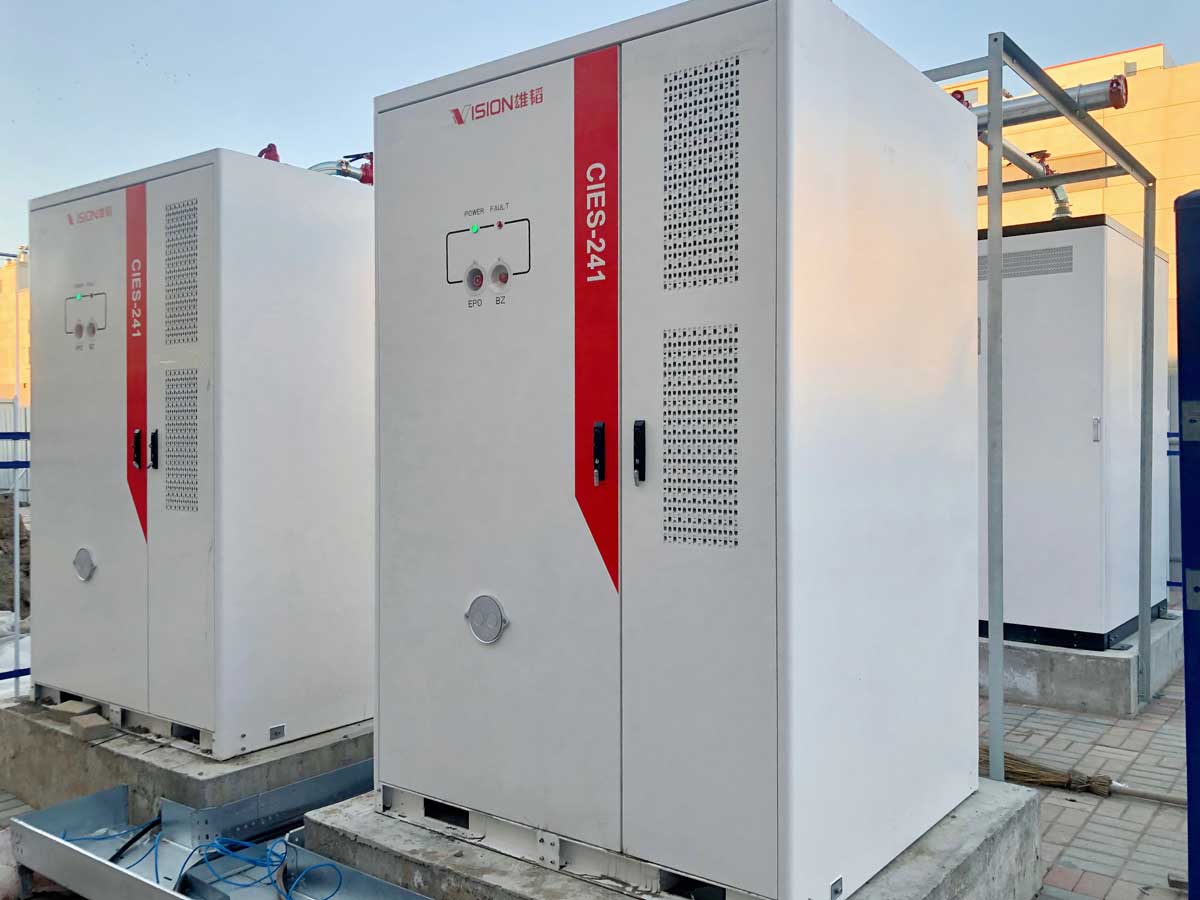
This is our own project, and we are describing it because it is the architecture above arriving all at once in one building rather than as four separate roadmap items.
AI & Big Data Computing Center · Inner Mongolia · 2026
800V HVDC immersion-cooled integrated storage and backup, for an AIDC serving a platform with over 900 million daily active users.
- Integrated duty rather than standby: the system charges and discharges for daily energy distribution while holding backup reserve, and transfers to backup if the grid fails.
- Semi-immersion cooling: cells are partially immersed in coolant, isolating heat from the air path and reducing both failure and fire risk relative to air cooling.
- Fully outdoor, IP55-rated, sand- and wind-proof, with intelligent temperature control — chosen for a genuinely harsh site.
- Compatible with 800V DC photovoltaic input, so on-site generation reaches the battery without an inversion stage.
- System efficiency above 92%, with the outdoor placement reducing the hall's cooling load and improving PUE.
Vision describes this as one of the first 800V HVDC integrated ESS and backup deployments in China's AIDC sector. It is a Chinese installation under Chinese standards. We are not implying a US equivalent exists today — that would be the exact kind of claim this site is built to avoid.
How to evaluate any battery vendor
Four questions. Apply them to us with the same force as to anyone else.
We are publishing this knowing it will be used on us. That is the point — a supplier who is uncomfortable with a checklist is telling you something.
“Send me the certificate number for this exact model and revision.”
Not the product line, not a family. A listing applies to a specific construction. If the answer is a paragraph rather than a number, the honest reading is that the listing does not cover what you are about to install.
“Send the cycle-life curve, with the test conditions.”
Depth of discharge, C-rate and cell temperature move cycle life by a wide margin. A cycle number without its conditions is marketing. A curve with its conditions is a specification you can design against.
“Do you manufacture the cell, or buy it?”
This determines who actually owns a cycle-life warranty and whether anybody can tell you why a batch behaved differently. A company that buys cells cannot answer process questions, because it does not control the process.
“Name an installation I can ask about.”
A project name, a year, a scale, and permission to reference it. Vendors with running installations produce this quickly. Vendors without one produce a diagram.
Our own answers, since it would be absurd not to give them. We manufacture the cell. The REVO 3.0 UPS system is UL 1973 certified and UL 9540A tested with no fire following thermal runaway; our containerized storage documentation currently publishes GB/T and IEC standards rather than UL 9540, and we say so on the energy storage page rather than waiting to be asked. Curves are released per model with their test conditions. References are named on the product pages with project year and scale.
Quarterly briefing
One email a quarter on data center power and the battery layer.
What changed in codes and listings, what density is doing to power architecture, and what we are actually seeing in deployments. No product announcements, no drip sequence, unsubscribe in one click.
If you would rather just ask a question, call (408) 309-1021 — Monday–Friday, 8:00–5:00 Central — or email sales@visionbattery.us. For anything you intend to specify, ask for the certificate number against the exact model and revision — from us and from everyone else on the list.
Questions
Definitions, plainly stated.
What do you actually supply into a data center?
Three things. The 800V HVDC sidecar battery, which is the rack-level backup for AI racks built to the 800 VDC distribution standard — 400 to 600 kW per cabinet, covered in full on the 800V HVDC page. REVO UPS lithium cabinets, for the conventional low-voltage UPS architecture that most existing halls still run. And CBES liquid-cooled containers where the storage sits outside the building. This page is the briefing on why the architecture is changing; those pages are the hardware.
What is 800V HVDC and why is it appearing in AI data centers?
High-voltage direct current distribution at around 800V, instead of converting to AC and back again at every stage. Each conversion costs efficiency and adds a component that can fail. As rack power climbs into the hundreds of kilowatts, the cumulative loss and the copper required for low-voltage distribution both become material, so distributing at higher DC voltage starts to win on both efficiency and physical footprint. It also aligns with DC-native sources like PV and with batteries, which are DC devices being forced through inverters today.
What is the difference between a UPS battery and an integrated ESS in this context?
A UPS battery is a sunk asset that does nothing until the grid fails. An integrated energy storage and backup system holds the same reserve but also charges and discharges against tariff or dispatch signals the rest of the time. The engineering consequence is that the battery is now cycling daily rather than sitting at float, which changes the cell selection, the thermal design, and the warranty conversation entirely. A cell chosen for standby duty is the wrong cell for daily cycling.
What does immersion or semi-immersion cooling do for a battery, specifically?
It replaces air as the heat-transfer medium between the cell and the cooling system. Air is a poor conductor, which is why air-cooled packs develop temperature gradients between cells, and gradients are what drive cells out of balance and shorten life. Immersing or semi-immersing cells in a dielectric coolant reduces cell-to-cell temperature difference and isolates a thermal event from the surrounding air path. It costs complexity and it is not free, but at high power density the trade starts to favour it.
Which certifications does a US data center plan reviewer actually ask about?
For the battery system itself, UL 1973. For an energy storage system, UL 9540 as the listing, with UL 9540A as the fire-propagation test method that informs it — those two are constantly conflated and they are not the same thing. NFPA 855 governs installation. If you are evaluating any vendor, including us, ask for the certificate number for the exact model and revision you intend to install rather than a statement that the product line is certified.
What is a realistic way to evaluate an unfamiliar battery supplier?
Ask for four things: the certificate number for the exact model and revision, the cycle-life curve with its test conditions stated, whether the company manufactures the cell or buys it, and a named reference installation you can ask about. A supplier who can produce all four is a candidate. One who answers three is a conversation. One who answers in adjectives is not a supplier.
What is in the quarterly briefing?
One email per quarter on data center power density and the battery layer — what changed in codes and listings, what the density curve is doing to power architecture, and what we are seeing in deployments. No product announcements. Unsubscribe in one click, and we do not sell or share the list.